
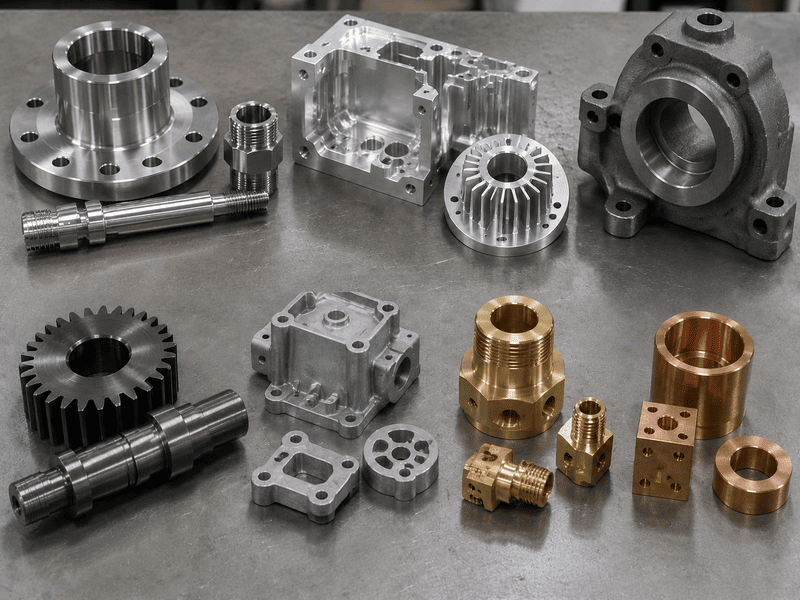
I often see buyers know a part name, but they still get wrong quotes. The pain grows when samples, drawings, and real working needs do not match.
The most common mechanical parts include gears, shafts, bearings, pulleys, sprockets, couplings, fasteners, bushings, brackets, springs, seals, and linear guides.1 I group them by function because each part must fit the load, speed, material, tolerance, surface treatment, and working environment.
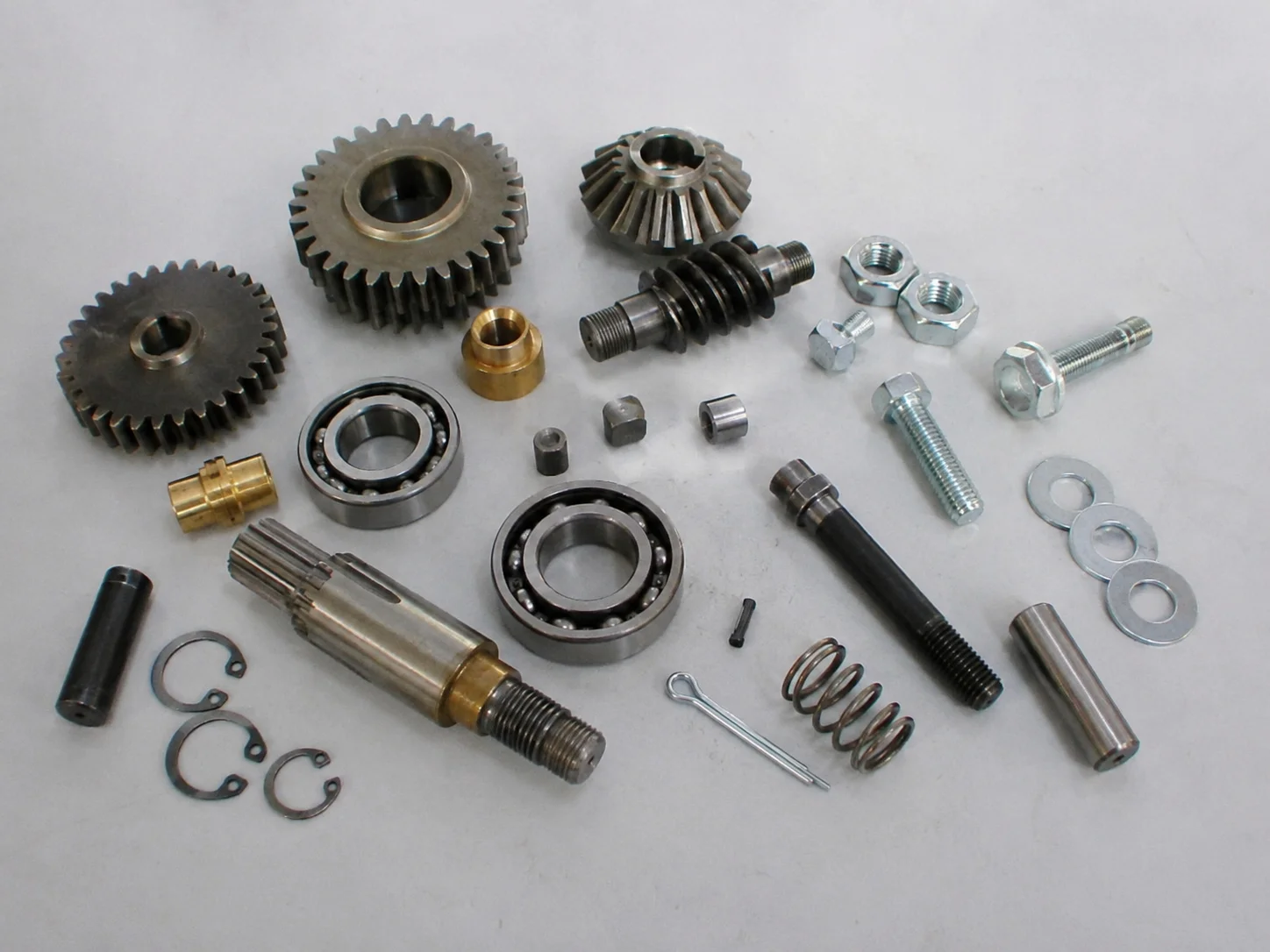
I do not treat common mechanical parts as a random list. I see them as working parts inside a machine system. One part transfers power. One part supports rotation. One part fixes position. One part guides movement. One part protects the machine from dust, oil loss, or wear. When I discuss a new order with an importer or wholesaler, I first ask what the part does in the machine. The answer is often more useful than the part name. A shaft for a small motor is not the same as a shaft for agricultural machinery. A gear for low-speed hand equipment is not the same as a gear for heavy industrial use. I keep this in mind because a simple name can hide many production details, so I keep reading the function before I judge the part name.
Which common parts transfer motion and power?
I often see sourcing mistakes start with transmission parts. The buyer says “gear” or “shaft,” but the machine needs much more than a name.
Gears, shafts, pulleys, sprockets, and couplings are common transmission parts. I use them to transfer motion, torque, and power from one place to another. Their design depends on speed, load, alignment, material, hardness, tolerance, and surface finish.2
I group these parts by power path
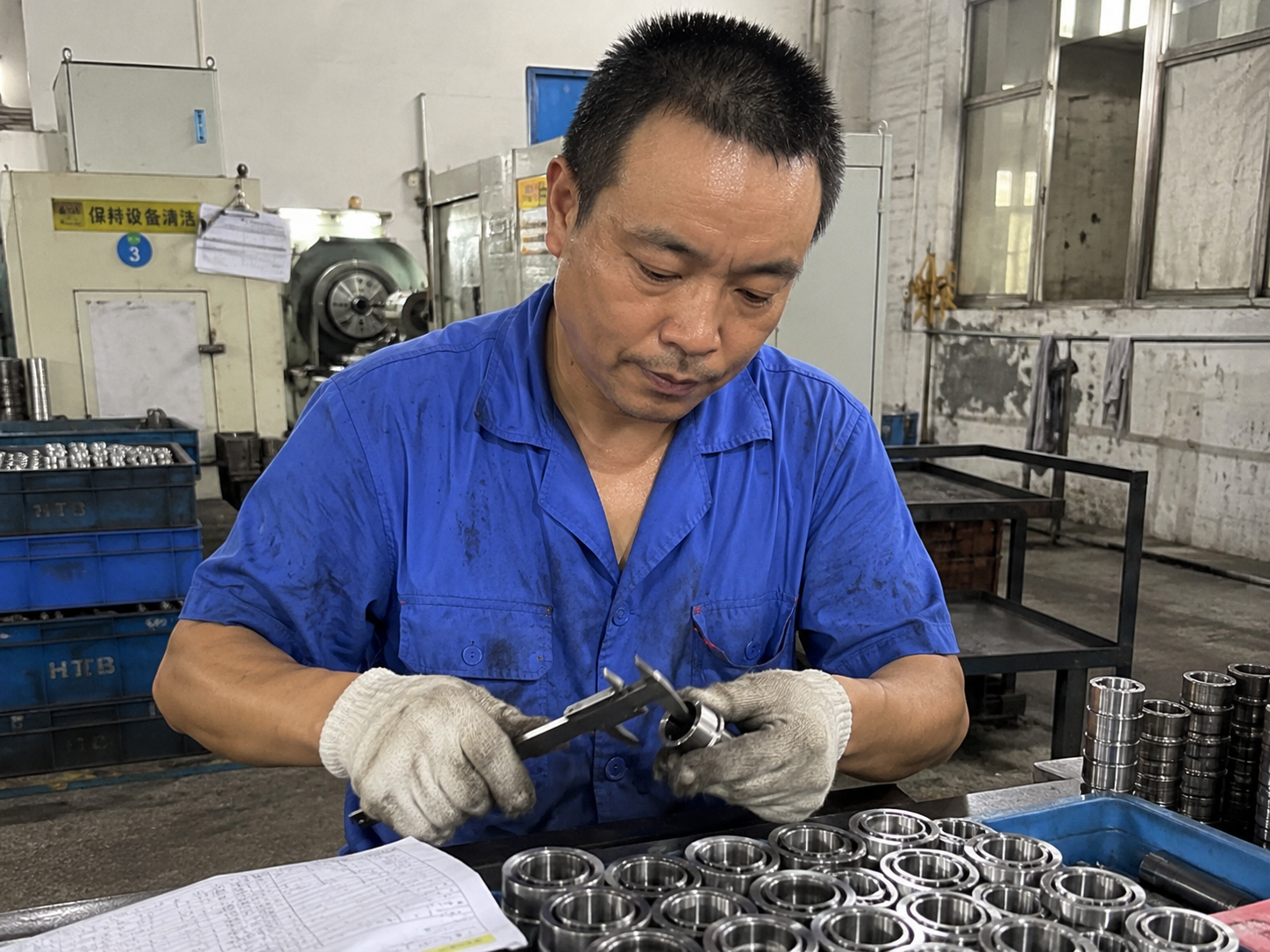
In my factory work, transmission parts are some of the first parts I check when a buyer sends a sample or drawing. These parts are common, but they are not always easy to source. A small change in tooth profile, shaft diameter, keyway size, or heat treatment can change how the part works. I do not need to do design calculations for a buyer at the quoting stage, but I do need to understand the working role. A gear may reduce speed and increase torque.3 A shaft may carry rotation through the machine. A pulley may work with a belt. A sprocket may work with a chain. A coupling may connect two shafts and handle small alignment differences.4 These points affect the process route. I may consider CNC machining, hobbing, turning, grinding, casting, forging, or heat treatment based on the part.
| Part type | What I expect it to do | Common buyer details I ask for |
|---|---|---|
| Gear | I expect it to change speed, torque, or direction. | I ask for tooth data, material, hardness, bore, and drawing. |
| Shaft | I expect it to carry rotation and load. | I ask for diameter, length, keyway, tolerance, and surface finish. |
| Pulley | I expect it to transfer motion through a belt. | I ask for groove type, bore, width, material, and balance need. |
| Sprocket | I expect it to move with a chain. | I ask for tooth number, pitch, bore, thickness, and surface treatment. |
| Coupling | I expect it to connect two rotating shafts. | I ask for bore size, torque need, material, and alignment condition. |
I see many importers focus on price first. I understand this because wholesale business depends on cost. Still, I think the first step is fit. If the part does not fit the load, speed, and assembly, the low price becomes expensive.
Which common parts support rotation and load?
I often see buyers order shafts and bearings together, but they forget that one part rotates and the other part supports that rotation.
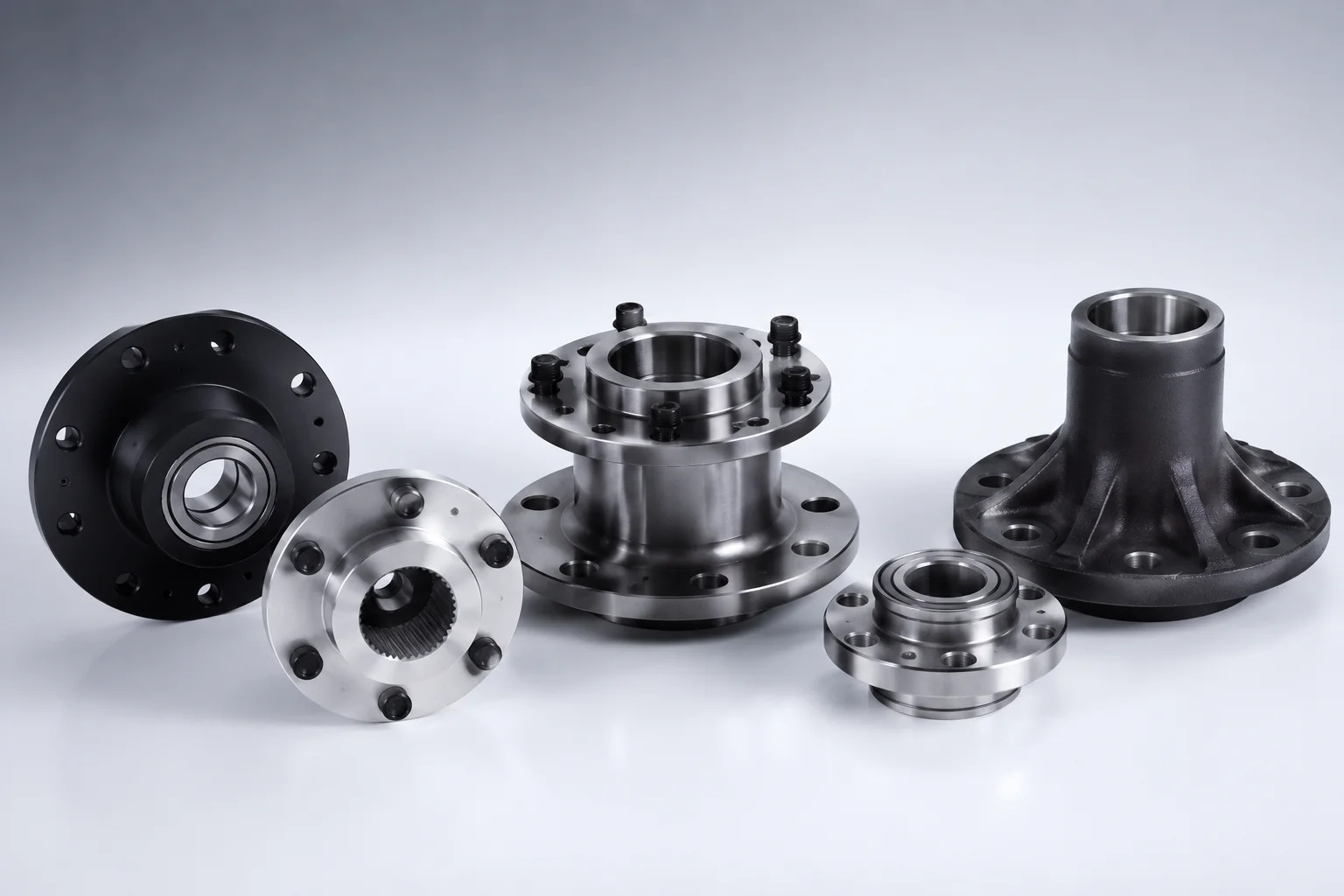
Bearings, bushings, shafts, housings, and collars are common support parts.5 I use them to carry load, reduce friction, hold position, and keep rotating parts stable. Their fit, hardness, lubrication, and working environment matter a lot.
I look at the support role before I look at the shape
A support part may look plain, but it can decide whether a machine runs smoothly. I often check the relation between a shaft, bearing, bushing, and housing. A bearing supports rotation with rolling elements.6 A bushing supports sliding or rotating contact with a simpler structure. A shaft collar holds a part in place on the shaft. A housing keeps a bearing in the correct location. These parts work together, so I do not check them as isolated metal pieces. I also ask about lubrication, dust, water, temperature, and load direction. For example, agricultural machinery may need stronger protection against dirt. Industrial automation may need better precision and smoother movement. Medical or energy equipment may need more stable material control and cleaner surface needs.
| Support part | Main function I consider | Procurement risk I watch |
|---|---|---|
| Bearing | I use it to support rotating motion and reduce friction. | The risk is wrong size, wrong load rating, or poor sealing. |
| Bushing | I use it to support sliding or rotating contact. | The risk is wrong material or poor wear resistance. |
| Shaft | I use it as the main rotating or supporting member. | The risk is wrong tolerance, bending issue, or bad surface finish. |
| Housing | I use it to locate and protect a bearing or shaft. | The risk is poor bore accuracy or weak mounting points. |
| Collar | I use it to hold parts in a set position. | The risk is loose fit or wrong screw structure. |
I always remind buyers that support parts need correct fits. A bearing seat that is too loose can move. A bearing seat that is too tight can damage assembly.7 A shaft surface that is too rough can shorten service life. These are not rare problems. I see them in real sourcing work when drawings are missing or samples are worn.
Which common parts connect, fasten, and locate other parts?
I often see buyers treat fasteners as standard items only. The problem appears when the bolt, pin, or bracket must hold real load in a real machine.
Bolts, nuts, screws, pins, washers, brackets, clamps, and keys are common connection parts.8 I use them to join parts, lock parts, locate parts, and keep assemblies stable during work, vibration, and service.
I check connection parts by assembly purpose
Connection parts may be standard or custom. I do not assume they are all simple. A bolt may need a certain grade. A pin may need grinding. A bracket may need welding, stamping, machining, or casting. A key may need tight size control because it transfers torque between a shaft and a hub.9 I often ask whether the part is removed during service. I also ask whether the machine has vibration, shock load, corrosion, or outdoor use. These details change material and surface treatment. Zinc plating, black oxide, phosphating, anodizing, painting, and heat treatment may be needed. For some parts, stainless steel may be better. For other parts, alloy steel with heat treatment may make more sense. I try to connect the part function to the right production choice.
| Connection part | How I see its job | Detail I need before quotation |
|---|---|---|
| Bolt and nut | I use them to clamp parts together. | I need grade, thread, length, finish, and quantity. |
| Screw | I use it for fastening or adjustment. | I need head type, thread type, material, and coating. |
| Pin | I use it to locate, hinge, or carry shear load. | I need diameter, length, tolerance, hardness, and end shape. |
| Bracket | I use it to hold or support another part. | I need drawing, thickness, hole position, material, and process. |
| Key | I use it to transfer torque between shaft and hub. | I need width, height, length, tolerance, and material. |
I have learned that connection parts can delay a whole order if the information is unclear. A buyer may send a photo of a bracket and ask for price. I can give a rough comment, but I cannot quote accurately without thickness, hole sizes, bend angles, material, and quantity. A simple part still needs clear data.
Which common parts guide, slide, and control movement?
I often see machines fail to move well because guide parts are treated like basic metal strips. Poor guiding creates noise, wear, and unstable movement.
Linear guides, rails, slides, lead screws, ball screws, cams, rollers, and springs are common motion control parts.10 I use them to guide direction, control travel, support repeat movement, or store and release force.
I connect movement quality with precision needs
Guiding and sliding parts are very important in automation equipment, packaging machinery, machine tools, medical equipment, and many custom machines. I do not judge these parts by shape only. I ask how the part moves. I ask whether movement is slow or fast. I ask whether the machine needs repeat position. I ask whether there is dust, oil, water, or high temperature. A rail may need straightness control. A slide block may need surface hardness. A lead screw may need accurate thread.11 A roller may need bearing quality and surface finish. A spring may need stable force, material control, and heat treatment. Some parts can be made by CNC machining. Some need grinding. Some need stamping or wire forming. Some are bought as standard parts, then assembled with custom parts.
| Motion part | What I expect it to control | Main sourcing point I check |
|---|---|---|
| Linear guide | I use it to guide straight movement. | I check size, accuracy grade, load, and rail length. |
| Slide rail | I use it to support repeated sliding. | I check material, surface treatment, and clearance. |
| Lead screw | I use it to convert rotation into straight movement. | I check thread, pitch, length, nut fit, and finish. |
| Roller | I use it to support rolling movement or feeding. | I check diameter, bearing, coating, and runout need. |
| Spring | I use it to store and release force. | I check wire diameter, material, load, and working cycle. |
I often tell buyers that motion parts need more than “same as photo.” A worn sample may not show the original size. A rail may look straight but still fail in assembly. A screw may look correct but bind under load. If the buyer can share application context, I can better check whether machining, grinding, heat treatment, or surface coating should be considered.
Which common parts protect, seal, and reduce wear?
I often see buyers notice seals and wear parts only after leakage or downtime happens. These small parts can stop a large machine.
Seals, gaskets, O-rings, wear plates, washers, spacers, covers, and guards are common protection parts.12 I use them to prevent leakage, reduce wear, keep distance, block dust, and protect nearby components.
I treat protection parts as service-life parts
Protection parts may not look expensive, but they often protect more expensive parts. A seal keeps oil or grease inside. A gasket closes a joint. A wear plate takes friction instead of the main structure. A spacer keeps the correct distance. A cover protects a bearing, chain, belt, or operator area. I ask about oil, water, chemicals, dust, temperature, and pressure at a basic procurement level. I do not claim to replace a lab test or full engineering review. I only use factory experience to ask better sourcing questions. Rubber, plastic, copper, brass, stainless steel, carbon steel, and alloy steel may all appear in this part group. The process may be injection molding, stamping, CNC machining, casting, or cutting from sheet material.
| Protection part | Why I use it | Sourcing detail I need |
|---|---|---|
| Seal | I use it to stop oil, grease, or dust movement. | I need size, material, lip type, and working medium. |
| Gasket | I use it to close a joint surface. | I need shape, thickness, material, and temperature condition. |
| Wear plate | I use it to take friction and protect the main body. | I need hardness, thickness, hole pattern, and surface finish. |
| Spacer | I use it to keep a fixed distance. | I need length, bore, outside diameter, and tolerance. |
| Cover | I use it to protect parts from dust or contact. | I need shape, mounting points, material, and finish. |
I see one common mistake in this part group. A buyer may match the outer size but ignore material. That can cause swelling, cracking, corrosion, or fast wear. I always prefer to know the working environment before I confirm a material or process direction.
What information do I need before sourcing common mechanical parts?
I often see buyers lose time because they ask for a quote before they prepare the basic part information. This makes supplier answers slow and unclear.
I need drawings or samples, dimensions, material, tolerance, quantity, surface treatment, application, and packing requirements before accurate sourcing. A part name helps, but it is not enough for a reliable quote or stable production.
I use a simple checklist before I quote
When I receive a new inquiry, I first try to understand whether the part is standard, semi-custom, or fully custom. If the buyer has a 2D drawing, 3D file, or original sample, the discussion becomes much faster. If the buyer only has a photo, I can still start, but I must ask more questions. I usually need main dimensions, material, tolerance, surface treatment, hardness, quantity, and use environment. I also ask about annual demand if the buyer is a wholesaler. This helps me think about machining route, tooling, casting mold, stamping die, inspection plan, and packing method. I keep this process practical. I do not ask for complex engineering data when it is not needed. I only ask for the details that affect manufacturing and quotation.
| Information I ask for | Why I ask for it | Example I may request |
|---|---|---|
| Drawing or sample | I need a clear reference for shape and size. | I may ask for a PDF, CAD file, or physical sample. |
| Material | I need to match strength, wear, and corrosion needs. | I may ask for carbon steel, alloy steel, stainless steel, or aluminum. |
| Tolerance | I need to know the precision level. | I may ask for key dimensions and fit areas. |
| Surface treatment | I need to price coating and protection work. | I may ask for zinc plating, black oxide, anodizing, or painting. |
| Quantity | I need to choose a practical production method. | I may ask for trial order and annual volume. |
| Application | I need to understand the working condition. | I may ask whether it works in automation, agriculture, or industrial machinery. |
I also check inspection needs. Some buyers need simple dimensional inspection. Some buyers need material certificates, PPAP-style documents, or custom reports. Some buyers need export packing for sea shipment. These details are part of sourcing, not afterthoughts. When I get them early, I can give a cleaner price and a more reliable lead time.
Conclusion
I see common mechanical parts by function first. When I know the function, I can match the part name with material, process, and sourcing details.
"Machine Element Design - MU Bert", https://mubert.marshall.edu/coursedescript.PHP?subj=ME&crse=340&term=202201. A mechanical-design or machine-elements reference classifies components such as gears, shafts, bearings, fasteners, springs, and seals as standard machine elements used in mechanical assemblies. Evidence role: definition; source type: education. Supports: A machine-elements or mechanical-design source should support that gears, shafts, bearings, fasteners, springs, seals, and similar items are standard mechanical component categories.. Scope note: Such sources support the general classification, not that this article's list is exhaustive or universally ranked by frequency. ↩
"[PDF] Precision Machine Design - MIT", https://web.mit.edu/2.70/Lecture%20Materials/Documents/Week%2005/PMD%20Topic%2020%20Rotary%20power%20trans.pdf. Mechanical-design references treat operating load and speed, material properties, dimensional tolerances, alignment, hardness, and surface finish as relevant variables in the design or selection of transmission components. Evidence role: expert_consensus; source type: education. Supports: An engineering source should show that load, speed, alignment, material properties, manufacturing tolerance, hardness, and surface finish are relevant factors in designing or selecting power-transmission components.. Scope note: The source would provide general engineering context rather than validating every sourcing decision described in the article. ↩
"How To Calculate Gear Ratios: Torque, RPM, & Mechanical ...",
. References on gear ratios explain that a reduction gear train can decrease output speed while increasing output torque, subject to efficiency losses. Evidence role: mechanism; source type: encyclopedia. Supports: A source should explain that gear ratios trade speed for torque in gear trains.. ↩"Learning+: Coupling and Shaft Alignment | Rockwell Automation | US", https://www.rockwellautomation.com/en-us/support/workforce-development-training/learning-plus/coupling-and-shaft-alignment.html. Technical definitions of shaft couplings describe them as devices used to connect rotating shafts, with many coupling types designed to tolerate limited angular, parallel, or axial misalignment. Evidence role: definition; source type: encyclopedia. Supports: A source should define shaft couplings as devices for connecting rotating shafts, including types that accommodate limited misalignment.. Scope note: The support is general; allowable misalignment depends on the coupling type and manufacturer specification. ↩
"Essential Components for Mechanical Engineers - Five Flute", https://www.fiveflute.com/guide/bearings-and-bushings-essential-components-for-mechanical-engineers/. Machine-design references describe bearings, bushings, shafts, housings, and collars as components used to support, locate, or constrain rotating machine elements. Evidence role: general_support; source type: education. Supports: A machine-design source should support that bearings, bushings, shafts, housings, and collars are common components used to support, locate, or constrain rotating parts.. Scope note: The source would support the functional grouping, not prove that these are always categorized together in every industry. ↩
"Rolling-element bearing - Wikipedia", https://en.wikipedia.org/wiki/Rolling-element_bearing. Definitions of rolling-element bearings state that balls or rollers are placed between races to support loads while permitting relative rotation with reduced friction. Evidence role: definition; source type: encyclopedia. Supports: A source should define rolling-element bearings and explain that balls or rollers support relative rotation.. ↩
"[PDF] Interference-Fit Life Factors for Ball Bearings", https://ntrs.nasa.gov/api/citations/20110000529/downloads/20110000529.pdf. Bearing installation and design guidance notes that insufficient interference can permit bearing creep or movement, while excessive interference can reduce internal clearance and create damaging assembly stresses. Evidence role: mechanism; source type: education. Supports: A source should explain that bearing fit selection affects creep, mounting stress, clearance, and potential bearing or assembly damage.. Scope note: The exact failure mode depends on bearing type, housing material, shaft tolerance, temperature, and operating load. ↩
"Fasteners and Bolted Joint Design - Five Flute", https://www.fiveflute.com/guide/fasteners-and-bolted-joint-design/. Mechanical-design references classify threaded fasteners, pins, washers, clamps, brackets, and keys as common elements used to join, locate, clamp, or transmit loads between parts. Evidence role: definition; source type: education. Supports: A source should support that threaded fasteners, pins, washers, clamps, brackets, and keys are common joining or locating elements in mechanical design.. Scope note: The terminology varies by textbook and industry, so the source may not use the exact phrase 'connection parts.' ↩
"Shaft hub connections in mechanical engineering - Felss", https://felss.com/en/blog/shaft-hub-connections-in-mechanical-engineering-technologies-comparison-and-standards/. Machine-elements texts describe keys as components fitted into shaft and hub keyways to transmit torque, making key and keyway dimensions important for proper fit and load transfer. Evidence role: mechanism; source type: education. Supports: A source should explain that keys and keyways transmit torque between a shaft and an attached hub, gear, or pulley, and that fit dimensions matter.. ↩
"Linear Motion System Theory - Industrial Solutions Lab", https://isl.charlotte.edu/linear-motion-system-theory/. Mechanical-design and motion-control references describe guides, slides, screws, cams, rollers, and springs as elements used to constrain, convert, repeat, or control motion in machines. Evidence role: general_support; source type: education. Supports: A source should support that linear guides, slides, lead screws, ball screws, cams, rollers, and springs are mechanical elements used to guide, convert, repeat, or control motion.. Scope note: The support is contextual because sources may discuss these components in separate chapters rather than as one unified category. ↩
"Ball and lead screw drunkenness - what is it and when does it matter?", https://www.linearmotiontips.com/ball-and-lead-screw-drunkenness-what-is-it-when-does-it-matter/. Engineering references on lead screws explain that rotary motion is converted into linear travel through the screw thread, so thread geometry and pitch accuracy affect positioning accuracy and smoothness. Evidence role: mechanism; source type: education. Supports: A source should explain that lead screws convert rotary motion into linear motion and that thread accuracy influences positioning or smooth operation.. Scope note: The magnitude of the effect depends on the lead screw class, nut design, lubrication, load, and required positioning precision. ↩
"Machine Guarding Policy - Environmental Health & Safety", https://www.safety.rochester.edu/ih/machineguarding.html. Engineering and machinery-safety references describe seals and gaskets as components used to control leakage or contamination, wear plates as sacrificial wear surfaces, and guards or covers as protective barriers around machinery. Evidence role: general_support; source type: institution. Supports: Sources should support that sealing components limit leakage and contamination, wear plates protect surfaces from wear, and guards or covers protect components or operators.. Scope note: No single neutral source may cover every listed part, so more than one source may be needed for complete support. ↩
Leave a Reply