
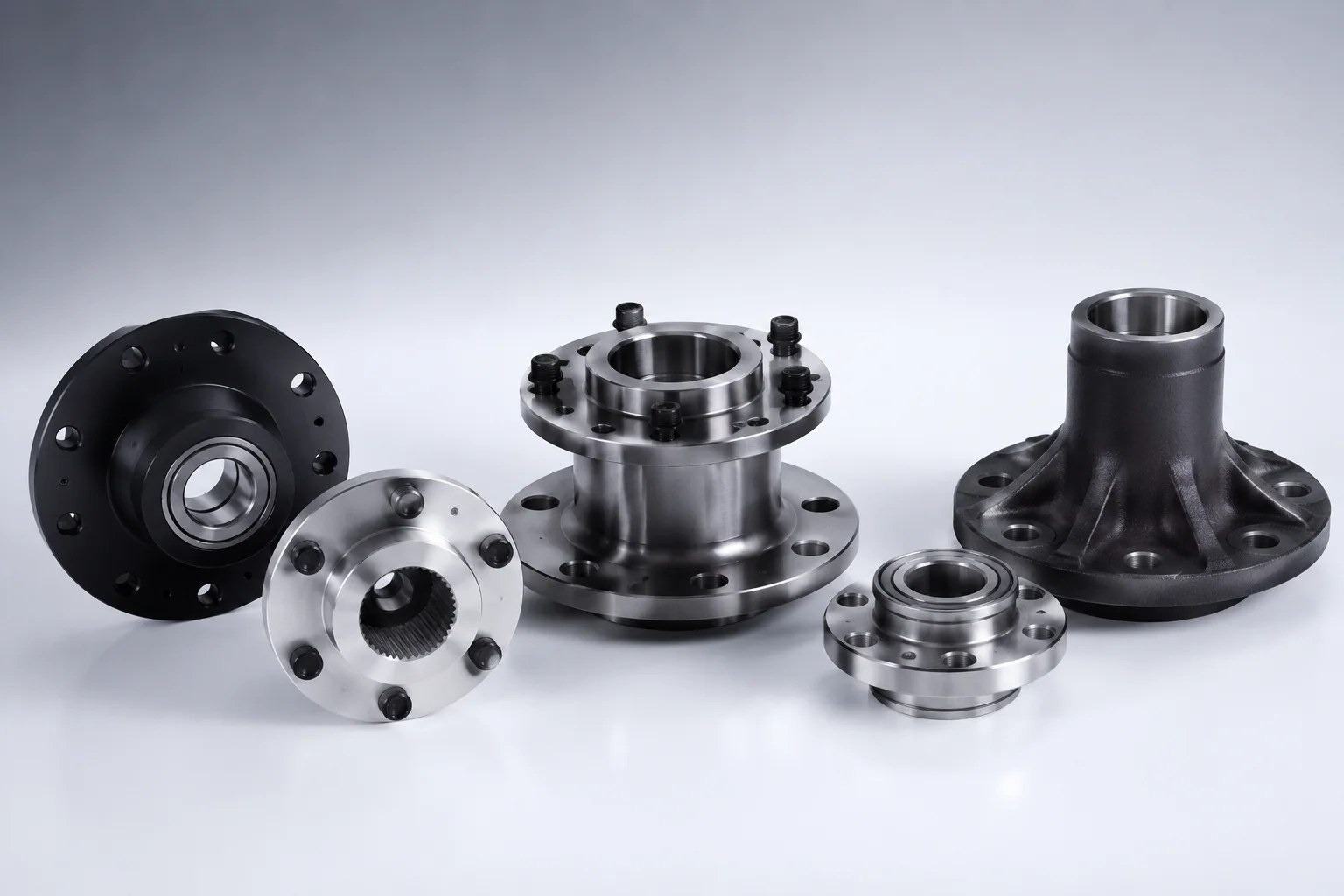
Wheel Hubs in Industrial Machinery: Functions, Types, Materials, and Manufacturing Guide
Introduction
In industrial machinery, automation systems, material handling equipment, agricultural machines, and transportation vehicles, wheel hubs play a critical role in ensuring smooth movement, load distribution, and operational reliability.
Although often overlooked compared to motors, bearings, or drive systems, a wheel hub serves as the central connection point between the wheel and the axle, directly affecting performance, safety, and service life.
For equipment manufacturers and industrial engineers, selecting the right wheel hub design and manufacturing process can significantly improve equipment durability while reducing maintenance costs.
What Is a Wheel Hub?
A wheel hub is a mechanical component that connects a wheel to an axle or shaft assembly. It provides a mounting surface for the wheel and often houses bearings, fastening systems, and drive interfaces.
- Automated Guided Vehicles (AGVs)
- Material Handling Equipment
- Construction Machinery
- Agricultural Equipment
- Industrial Carts and Trolleys
- Mining Equipment
- Logistics Systems
- Transportation Vehicles
- Robotics and Mobile Platforms
The wheel hub must withstand radial loads, axial loads, impact loads, and torque transmission during operation.
Main Functions of a Wheel Hub
1. Load Support
Transfers equipment weight and payload through the wheel assembly to the axle system.
2. Torque Transmission
Transmits driving torque from motors or drive shafts to the wheel.
3. Bearing Integration
Allows smooth wheel rotation while maintaining alignment.
4. Wheel Positioning
Ensures accurate wheel mounting and minimizes vibration.
5. Structural Connection
Acts as the interface between wheels, shafts, bearings, spacers, and fastening components.
Common Types of Wheel Hubs
Flanged Wheel Hubs
- Easy installation
- High mounting stability
- Suitable for heavy loads
Applications: Industrial vehicles, forklifts, material handling systems.
Splined Wheel Hubs
- High torque capacity
- Excellent alignment
- Reduced slippage
Applications: Construction machinery, agricultural equipment, heavy-duty drive systems.
Keyed Wheel Hubs
- Cost-effective
- Simple design
- Easy maintenance
Applications: Industrial machinery, conveyors, automation equipment.
Taper Lock Hubs
- Easy assembly
- Strong clamping force
- Good concentricity
Applications: Industrial drives and power transmission systems.
Materials Used for Wheel Hubs
Carbon Steel
- AISI 1045
- AISI 4140
- S45C
Offers high strength, excellent machinability, and cost efficiency.
Stainless Steel
- 304 Stainless Steel
- 316 Stainless Steel
- 17-4 PH Stainless Steel
Provides excellent corrosion resistance and durability.
Aluminum Alloys
- 6061-T6
- 7075-T6
Lightweight with a high strength-to-weight ratio, ideal for robotics and AGVs.
Ductile Iron
Known for wear resistance, vibration damping, and load-bearing capability.
CNC Machining of Wheel Hubs
CNC Turning
- Outer diameters
- Bearing bores
- Shaft interfaces
- Concentric surfaces
CNC Milling
- Bolt hole patterns
- Keyways
- Splines
- Mounting features
Drilling and Tapping
- Threaded holes
- Fastener locations
- Lubrication ports
Grinding
Used when ultra-high precision and superior surface finish are required.
Important Quality Requirements
Concentricity
Poor concentricity may result in vibration, wheel wobble, and premature bearing failure.
Dimensional Accuracy
Critical dimensions include bearing seats, shaft bores, bolt circle diameters, and mounting surfaces.
Surface Finish
Improves bearing fit, assembly accuracy, and wear resistance.
Material Integrity
Manufacturers should verify material certifications, heat treatment records, and mechanical properties.
Surface Treatments for Wheel Hubs
Zinc Plating
Provides cost-effective corrosion protection.
Black Oxide
Offers a clean appearance with mild corrosion resistance.
Powder Coating
Creates a durable protective finish.
Hard Anodizing
Commonly applied to aluminum wheel hubs to improve hardness and wear resistance.
Custom Wheel Hubs for OEM Equipment Manufacturers
Many industrial equipment manufacturers require custom wheel hubs designed for specific operational requirements.
- Specific load capacities
- Unique wheel geometries
- Special mounting interfaces
- Lightweight structures
- Corrosion-resistant applications
- High-speed operation
Typical OEM manufacturing workflow:
- Engineering drawing review
- Material selection
- Prototype machining
- Dimensional inspection
- Functional testing
- Batch production
- Final quality control
Choosing a Reliable Wheel Hub Manufacturer
Manufacturing Capabilities
- CNC Turning
- CNC Milling
- Multi-axis Machining
- Surface Treatment Services
- Assembly Operations
Quality Management
- ISO 9001
- IATF 16949
- ISO 14001
Inspection Equipment
- CMM
- Height Gauges
- Surface Roughness Testers
- Hardness Testers
Engineering Support
- Design Optimization
- Cost Reduction
- Material Recommendations
- Manufacturability Improvements
Conclusion
Wheel hubs are essential components in industrial and mobile equipment. Their design, material selection, machining precision, and quality control directly influence equipment performance, reliability, and lifespan.
Whether used in automation systems, material handling equipment, agricultural machinery, or heavy industrial vehicles, a properly engineered wheel hub ensures smooth operation and efficient power transmission.
For OEM equipment manufacturers, partnering with an experienced precision machining supplier helps achieve consistent quality, optimized designs, and reliable long-term performance.
Leave a Reply